The Freedom Paradox
A woman I spoke to recently said something I’ve heard in different forms for years, but she said it without sugarcoating it:
“I want clients. I just don’t want to feel trapped by them.”
Not “fear of visibility.” Not “lack of clarity.” Not “money mindset.”
She was worried about getting what she said she wanted.
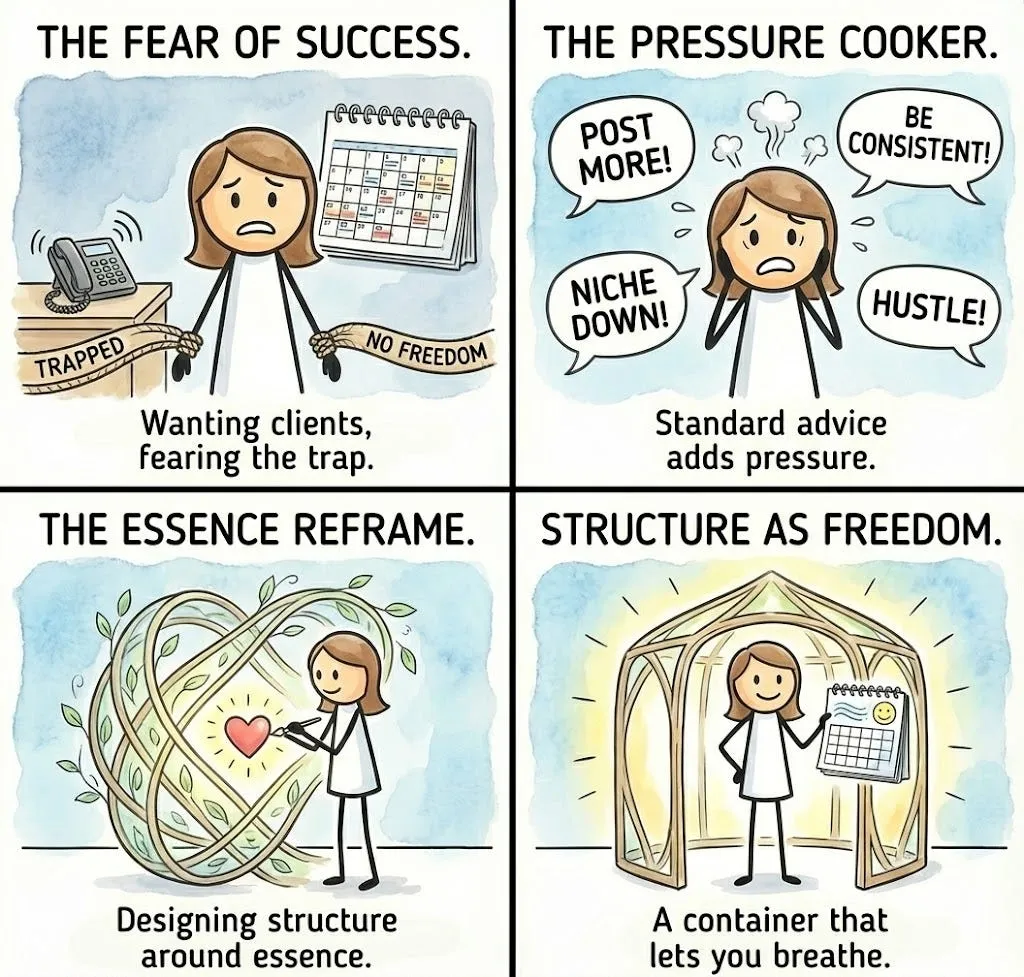
She’d just finished a landing page and was feeling really good about it. But the moment she imagined three clients booking in the same week, her stomach dropped. Not because she thought she couldn’t deliver, but because she imagined losing the spaciousness she built her whole life around.
And this, in my experience, is the part business advice often doesn’t touch:
Success introduces a new set of problems most people aren’t prepared for.
Online, you mostly hear about the first set:
- how to post
- how to package
- how to “show up”
- how to grow an audience
But almost no one talks about the second set:
- who you have to become to hold demand
- how your relationship to time changes when people want access to you
- how your nervous system reacts when money depends on you showing up
- how quickly self-trust collapses the moment your business becomes real
This is where most people get stuck, even if they don’t call it that.
The woman on the call (I’ll call her Meghan) said something that captured this perfectly:
“I want to do business my way. And I don’t want structure to run my life.”
I get that. I’ve been there.
Freedom is something I deeply value in my life.
Not in the Instagram-inspirational sense.
Literally.
I remember a season where my calendar looked fine on paper, decent number of clients, reasonable hours, but internally, I was dreading sales calls.
Every one felt like it took more energy than it should.
I didn’t trust myself inside the structure I had built for my offer. I was afraid it was going to burn me out.
And because I didn’t trust it, I was struggling to get my energy right to show up for these calls.
That’s usually the point where people tell you to “work on your mindset.” But the real issue isn’t mindset. It’s misalignment between the structure and the person who has to live inside it.
When Meghan talked about her fear of being “tied” to a weekly schedule, she wasn’t being dramatic. She was describing something practical: she had never experienced a version of structure that didn’t feel like pressure. In her past, structure equaled control, demands, perfectionism, or over-responsibility.
So why would her body suddenly relax just because she’s now her own boss instead of an employee?
It won’t.
The nervous system doesn’t care about that. In fact, in many ways the stakes are higher.
This is why people say they want clients but unconsciously avoid the actions that get clients. It’s not sabotage. It’s self-protection.
If structure has always felt like losing freedom, your brain will resist anything that looks like more structure, even if it’s good for your business.
That’s what was happening with her.
And this matters because the usual advice doesn’t help here.
“Post more.” “Be consistent.” “Niche down.” “Just trust yourself.”
If anything, these instructions make the problem worse. They add pressure on top of pressure.
So the question becomes:
How do you build a business that doesn’t require you to betray the way you’re wired?
Here’s what I told her.
There is a version of structure that doesn’t feel like a trap. This is where skeptics usually roll their eyes, so let me be specific.
There’s a guy in the online space I know who only offers one-off calls. He charges a few hundred dollars. And he does the calls while doing dishes or walking his dog.
Literally.
He tells clients upfront exactly what to expect.
No pretense. No polished backdrop. No forced “coach voice.”
He made a structure that matches how he wants to live. And because it matches him, it works.
The point isn’t that you should coach while doing dishes.
The point is:
You can design containers based on your reality, not someone else’s expectations.
Meghan hadn’t considered that option. Most people don’t. They assume “becoming a coach” means inheriting the entire coaching industry’s norms.
Weekly calls. Tight calendars. 24/7 access. Six-month commitments.
None of which she wanted.
And the truth is, she doesn’t need any of it.
What she needed was a structure built around her and only her.
Not the market. Not trends. Not “best practices.” Not spiritual clichés.
Her real nervous system, real energy, real lifestyle, and real strengths.
What structure actually is (not what you’ve been sold)
Structure is not:
- a strict calendar
- a complicated funnel
- a 20-step content plan
- a productivity system
- a masculine/feminine spiritual analogy
Structure is simply the environment your work lives in.
It is the set of boundaries that makes your work sustainable.
The right structure does three things:
Protects your energy
(fewer decisions, fewer moving parts, fewer emergencies)
Clarifies your value
(people know exactly what they are buying)
Creates a consistent way for people to find and pay you
(so you’re not reinventing your business every week)
None of this requires you to become a different person. What it does require is honesty about how you actually operate.
Meghan would likely thrive in shorter, intuitive sessions. She might work best when things feel fluid. She hates weekly obligations. She wants spacious days and minimal context-switching.
Great. That’s enough to design around.
In her case, a viable business might mean:
- one flagship offer, not three
- a booking system with only two days a week open
- sessions capped at a format that doesn’t drain her
- pricing that reflects the emotional intensity of intuitive work
- marketing rhythms that don’t require her to perform daily
- using AI to handle the repetitive parts she dislikes
No “identity shift” required. Just honest structure.
What this means if you recognize yourself in this story
If you want clients but fear the commitment, the problem is not your fear.
It’s the mismatch between your life and the structure you think you’re “supposed” to build.
You may not need more confidence. You may not need more content. You may not need more inner work.
You may simply need a way of doing business that doesn’t set off your internal alarm system.
And once that happens, the fear relaxes. Not because you became a different person, but because the container finally fits you.
This is the core of our approach: essence first, structure second.
Not structure as restriction or lack of freedom. Structure as protection. Structure as clarity. Structure as the thing that lets your actual work exist in the world without draining you.
You do not need to earn freedom later. You need to build with freedom now.
Most people don’t know that’s possible. Meghan didn’t. And when a client sees this for the first time, something shifts—not in their mindset, but in their body.
That’s the moment business stops feeling like a threat and starts feeling like something you can actually hold.